Thursday, November 3, 2011

Introducing the 2011 South Wedge Winery Apple Wine

For some reason, the naming of apple-based beverages is unnecesarily confusing. This led to an awkward conversation between myself and a couple people at a local apple orchard. While trying a sample of their fresh apple cider, the following conversation happend (its very likely that this is not entirely accurate, but thats how I remember it):


Guy at the Cider counter hands me a little cup and I sip from it.
Me: Not bad. Do you guys sell just plain apple juice here?
Guy behind counter looks at me with a befuddled look.
Lady who was arranging produce nearby: I think you can probably get that from Wegmans
Me: I'm just looking for some fresh apple juice that I can use to make hard cider. You don't sell that here?
Guy: This cider will work for that.
Me: But doesn't the cider have spices in it?
Guy: No no. Its just apples pressed this morning and UV pasturized.
Lady: Mulled cider has spices in it.
Jaime: The hot cider is usually spiced, but I don't think cold cider is.
Me: So this cider is nothing but apples? No sugar or anything added?
Guy: Its just apples pressed this morning and pasturized with UV light. Nothing added. Most apple juice is heat pasturized so that is why it looks different from cider. Ours is UV pasturized so it keeps the extra flavor.
Me: Ok, thank you.
I purchase two gallons and meekly retreat away, ashamed of my lack of cider knowledge.

So after a little internet research, I have learned the following about apple beverages:
Apple Cider: Fresh pressed apples, only coarsely filtered, usually heat pasturized for contamination control
Apple Juice: Cider that has been very well filtered and pasturized. Hot Cider: Apple cider that has mulling spices added and then is heated.
Hard Cider: Apple juice or apple cider that has been intentionally fermented
Apple Brandy: Distilled hard cider
Apple Jack: Same thing as apple brandy, though, interestingly, it used to be distilled by fractional freezing and removing the ice crystals, which would make it technically not a brandy
Apple Schnapps: A neutral-flavored malt-based spirit flavored with apple juice or apple flavoring and usually has extra sugar added.
Apple Wine: Nothing is really called apple wine.....until now.
Maybe I'm the only one who is confused by all this, but it seems like a terrible naming scheme. After all, apple cider and apple juice are pretty much the same thing, and hard cider is really just apple wine. Ugh. Well, I'm going to call the stuff I'm making apple wine.

I currently have two different kinds of yeast. One is bread yeast, and I'm pretty sure that would make some pretty gross flavors in the wine, so I'm not going to use that. The other is a wine yeast (actually a champagne yeast) capable of fermenting to 14+% alcohol. Most commercial hard cider either uses a beer yeast which typically can't ferment past about 6% or (more likely) use a stronger yeast but shock it with a preservative to halt fermentation at the desired alcohol percentage. Most commercial hard ciders are also way sweeter than I'd like. The best ones I've had were considered very dry (less residual sugar), so I think the champagne yeast should work out well. It should convert nearly all of the sugar into alcohol.

I expected that my apple wine might be able to reach 7-8% alcohol, but to my surprise, the hydrometer reading (measuring the approximate sugar content) showed a potential alcohol content of 12%. Well, this could be some interesting wine!

I did add two things besides yeast. I added a 1/2 tsp of "yeast nutrient" which was described to me as vitamins for the yeast since they use up a lot of the stuff that they need in the grape/apple juice. Also, I added about 15 drops of a solution of pectic enzyme. Its often used to help break down fruit mashes and release more juice/flavor. It should also help to break down any pectin in the juice and help to clarify it. I've had the pectic enzyme laying around for the last couple years because I was at a wine making store and figured that I might want to make some fruit wine at some point in the future.

Rather than go through the whole ordeal of sanitizing a bunch of fermentation equipment, I decided to try a less formal fermentation process that I saw online a while ago. I fermented it in the one-gallon plastic jug that it came in. To make an airlock, I used a balloon stretched over the top. I put a pin-hole in the balloon, and as the fermentation produces CO2, the balloon stretches just enough to let the CO2 out of the pin-hole, but doesn't let any oxygen in. Seems like a pretty good quick-and-dirty type approach. Here is what it looks like just after putting the balloon on.


Here is what it looks like after about 12 hours. Fermentation is already moving along pretty good at this point. The airlock seemed to work pretty well.

Wednesday, November 2, 2011

The Root Cellar

A couple times I've mentioned my "root cellar". The root cellar is just an area of the basement where I store vegetables that don't need to be refrigerated. Like a real root cellar, its cool but not cold, moderately humid, and relatively dark. I've had mixed results with storage down there. Onions and garlic have worked pretty well. Carrots not so much. Some of last year's spaghetti squash (harvested in fall of 2010) rotted within a month, but there is still a 5lb specimen that looks perfectly fine. Some potatoes have been fine, while others went soft or rotted.


My recent harvest of 40+ pound of potatoes got washed, then put in a somewhat breathable satchel and put on the floor in the root cellar. A couple weeks after putting them there, I went to grab a bunch to take to some friends, and I found that quite a few of them were rotten. Like smelly juices soaking through the bottom of the bag and making a puddle rotten. Some of the potatoes had holes and blemishes in them when I harvested them, so I suspect that they were either already rotting inside or the water from washing them provided enough moisture to allow bacteria or fungus to thrive. I definitely should have at least let the potatoes dry out thoroughly before putting them in the bag and leaving them in the basement.


Between the potatoes that rotted, the ones that I gave away, and the ones that we've eaten, I'm probably down to about 15+lbs. In the picture below, you can see a three-tier wire rack that I'm using for storage. It contains the loose produce and still allows good ventilation. The top level is onions and garlic and the lower two levels are the remaining potatoes. In the bottom right you can also see the 13+ month old spaghetti squash.

Tuesday, November 1, 2011

2010 South Wedge Winery Traminette Review

Its been quite a while since I've posted about our 2010 Traminette. There are a few reasons for that. Lack of time and laziness played a part, but a big part of it was also due to me avoiding a review of the wine. I tasted it during each stage of production from raw juice to a few weeks after bottling, and I wasn't too impressed with the last tasting I did. I'm hoping that letting it rest for a few months improved it.

Here is what it looks like. Good color. The aroma has a nice fruity and floral scent(kind of like jasmine), but there is also a bit of a chemical scent. Not overwhelming, but its there.

The first flavor is definately fruity and floral again. Apricot and canned peaches, I would say. Also a bit of honey. I think the flavor of the grape comes through pretty well. A larger sip or several sips in succession produces somewhat of a bitter chemically flavor. Its got a moderate amount of sugar, and that is balanced nicely by the moderate acidity.

Overall, I'd have to give this a 5 out of 10. I don't think its particularly good, but I'd buy it if it was cheap...like under $8.

Knowing what I do about the background of this wine, I have a couple theories as to why it didn't turn out quite as well as I would have liked. As for the chemical flavor, I suspect that might be caused by potasium metabisulphite(heretofore called sulfite). That is the main chemical that is used to prevent bacterial contamination. Its also the stuff that people talk about in cheap wine that gives some people headaches. The vineyard that I bought the wine from sells the grape juice with an initial dose of the sulfite to kill of bacteria that were hanging out on the grapes. The instructions I followed this time said to add a dose of sulfite after each major step in the process, so I added it as directed after primary fermentation and then again after secondary fermentation, and lastly between cold stabilization and bottling. That means it got dosed 4 times. Afterwards, I realized that in the past, I've only dosed the sulfite once before bottling (in addition to the initial sulfite that the vineyard put in). I've read that if the wine has too much sulfite in it, you can taste a chemically flavor.


The other problem that this wine has is the inherent flavor in the grape. The grape's flavor is not really bad, but its not really good, either. It almost tastes more like mead than wine. Traminette is a hybrid of Gewurtztraminer and a more cold-hardy grape that produces more heavily in the finger lakes region. I chose this juice for two reasons. One is that I really like Gewurtraminers, and especially Gewurtraminers from the finger lakes. The other reason was that the Traminette was cheap. Gewurtraminer juice is over $20 per gallon, while the Traminette was $10 per gallon. Unfortunately, you don't have a chance to taste the juices before you buy them, you have to reserve the juice ahead of time. A limo driver for a wine tour I was on once told me that the more expensive juice is worth the money because you can't make good wine without good juice. While I wasn't really confident enough in my winemaking skills to spend $120 on 6 gallons of juice vs. the $60 for the Traminette, I think the next time I make wine, I'll go for the good juice....and also not put as much sulphite in it.

Friday, October 28, 2011

First Freeze of the Year

It really is that time of year. We finally had our first frost/freeze of the year last night on 10/27. I saw the freeze warning, so I figured I should pick the remaining frost sensitive veggies left in the garden. That included beans, zucchini, peppers, and some of the greens. Not much fun picking vegetables in drizzly 40 degree temps as the light was fading, but I got it done. From left to right in that picture are sweet "popper" peppers, bell peppers, the bucket with zucchini and beans, cayenne peppers, scallions, and arugula. I cut the pepper plants at the ground and I'm glad I did because it was a lot easier to pick the peppers off the plant while they were waist-high in front of me rather than bending over to search for the peppers.
Here is what the almost 3 pounds of cayenne peppers looked like. There was one good burst of peppers in mid-summer and while those ripened the plants kept growing, but didn't seem to make many more flowers. Then after the first set had ripened, the plant exploded in tons more flowers in mid-late september and kept flowering through October. Unfortunately, that second set didn't have time to mature. I probably should have picked the peppers from the first set as soon as they turned red, but I left them on thinking they would keep better on the plant. I'm not sure if that slowed down the second batch or not. If I grow these again, I'll probably pick the ripe ones and let them dry. By the end of the year, the first ones had pretty much dried out on the plant as it was.
This is what more than 9 pounds of mixed peppers looks like. I gave away a bunch of these, but I probably still have about 5 pounds left. I'll be making stuffed peppers soon, and I'll probably chop some up and freeze them. The red cayennes I will almost certainly use to make some hotsauce.
I took a look at the garden today and it looks like the bean plants, and the zucchini definitely got hurt pretty bad by the frost/freeze. Asparagus, broccoli, and peas all survived the temps, but are probably done for the year. There are still pak choi, rapini, lettuce, kale, and one very small cauliflower head that can be harvested. None of these guys seem to be growing anymore, though.

Saturday, October 22, 2011

2012 planting

I've already started planting for next year. After digging up the potatoes, I sprinkled what remaining chicken manure (dried, pelleted) fertilizer I had left on the area, then turned over the dirt with a shovel. I saw some of the fattest worms I've ever seen in there. When they were not extended, they were about 4-5" long and almost as wide as a sharpie marker. Thats got to be a good sign for the dirt.

After turning over the soil, I planted a few different things. First was 12 cloves from the garlic that I harvested in July. According to the internet the size of the garlic plant and the yield is proportional to the size of the clove that is planted, so I took the biggest cloves from three different bulbs. Some of them were quite large and most, if not all, were larger than the cloves that I planted last year.

Next up was the "potato onions". I'd read about these previously online. They are supposed to be kind of between shallots and regular onions. Each plant makes 4-8 bulbs of varying size, the largest ones probably being almost the size of normal onions. Much like garlic, you can just just keep a few of the onions to plant for the next year and eat the rest. Supposedly they are what most people used to grow in their own veggie patches 100 years ago, but fell out of favor because they weren't really appropriate for large-scale farming. I do plan to plant some regular onion sets in the spring in case these don't live up their promises.

Lastly, I planted a small quantity of fancy french shallots. Supposedly they are the kind that are most prized by foodie types. I'm not sure that I have a refined enoung palate to care about such things, but I figured I'd give them a shot. Again, these should hopefully produce a cluster of shallots for each one that I plant.

I probably should have taken a picture of all this stuff before I planted it, but I forgot to. These all get planted in the fall because it gives them time to start a good root system and get primed for fast growth in the spring. This variety of garlic is quite hardy and shouldn't have a problem surviving the winter around here (no problem last year), but the potato onions and shallots are somewhat less hardy. These potato onions are supposedly ideal for Virginia. To try to help them survive the winter, I put about 3" of compressed leaves on the area, and then I put some of the potato vines on top just to keep the leaves from blowing away. Here is what it looked like when I was done. Hopefully those fat worms don't eat all the insulation before winter.


Wednesday, October 19, 2011

Potatoes!

Here is what the garden looks like in mid-october. Its still surprisingly green and growing. The potatoes (bottom right) look like they are just starting to die out. It doesn't matter if they are done or not, because I need to plant next year's garlic where they are now!
After some digging it quickly became apparent that the early-season Red Norland potatoes (died off in early july) did not do too well this year, while the late-season Kennebec Whites (the ones that are still alive in the picture above) exceeded expectations. Thats why I planted a couple different varieties. If the conditions are poor for one kind, they might still be good for the othe kind. After all the digging and washing, this is what the potatoes looked like. I put the camera lens cap there for some scale, but it still doesn't quite convey how big some of those white ones are. How much potatoes is that you ask? After taring the weight of the bin, those potatoes weighed in at 41.2lbs!! I've already asked Jaime to start looking into potato recipes, but its likely that we'll have to give some away because there is no way we can use that many potatoes. Combined with the 2.5lbs of red potates I harvested earlier in the year, that comes to 43.7 lbs. Approximately 5lbs were red and 38lbs were white.

Monday, October 3, 2011

Here fishy fishy fishy

The Miller homestead focuses mostly on growing vegetables, but we also take part in harvesting fresh local protein when the opportunity arises. Late September is the beginning of the local Salmon run. While the pacific northwest seems to get all the salmon run press, we have one as well, right within the city limits of Rochester.


Last year I went out with a few friends and tried to catch salmon with absolutely no luck, not even a bite. This year, I've been out a couple times with my friend Mike. The first time I had one on, but it got off as we were trying to figure out how we were going to land it without a net. The second time, Mike brought a net and we fared better. He landed this "small" 14lb King Salmon. I say small because other people who were nearby told us that this was smaller than average and they get a lot bigger (up to 40lbs or so).

After spending a little while figuring out how to gut it and remove the head, we took it home for further processing.
We probably spent about 1.5 hours cutting this thing up. Mostly it took that long because we didn't really know what we were doing, but it also took a while to remove all the pin bones. In the end, we were left with two sizable filets that we portioned. In the end there was about 5.5lbs of meat. I haven't actually had a chance to try it yet, but hopefully its yummy.

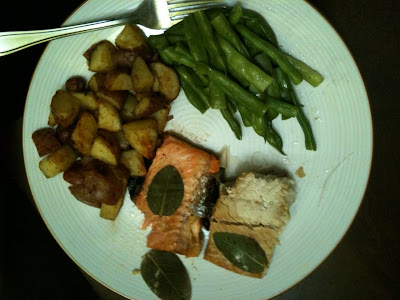
I was a bit hesitant to eat the fish since I had heard some unflattering things about Lake Ontario Salmon, but I did give it a try. I pan seared the Salmon and did a side-by-side comparison to some wild Washington state Coho salmon. In the picture below, the Coho is the pinker one. I actually had some wild King from Washington state and it was paler than the coho, but not as pale as the fish we caught. The Lake Ontario Salmon was significantly milder than the wild Coho. Much less fishy, but also less flavor in general. The texture was good. It was moist and soft. Not bad at all. I would eat it again, which is good since I have another 1.5 lbs of it! Also of note from this meal, the beans and potatoes are from the homestead, as well as the rosemary and sage used to season the potatoes and fish. Also had a pretty solid harvest from the garden this week. >1 lbs of bell peppers, >2 lbs of green beans, plus small amounts of broccoli, peas, and small peppers. The peppers that you see in the picture below had to be harvested because the branch they were on broke off due to the weight of the peppers and the heavy rain we got over the weekend.