Sunday, February 20, 2011

Testing A Seed Starting Setup

For Christmas this year, I got a grow light setup. I'm planning on putting a timer on the light and planting some seeds next month before I go away on a 3 week trip. Hopefully they'll be sprouted and happily growing by the time I get back. The problem is how to make sure they stay watered while I'm gone. I'll be growing the stuff in seed trays which will be sitting inside a bigger tray (a flat). Underneath the flat I'll have a heating pad that should help keep it a bit warmer than it would otherwise be. It will look something like this:
There are a few things to note in the picture. First is that some of the trays look like they have dirt in them. They do. I planted some arugula because it is very fast growing and might actually be large enough to produce a bit of useful greens before I leave. I also planted a few onions just to try growing onions from seed rather from onion sets or transplants. Onions take a long time to grow from seed, so you need to start them in mid-winter if you want to grow them from seeds to onion bulbs. Another thing to note in the picture is that I put a bunch of empty trays in the flat. I did that to reduce the amount of evaporation and also heat loss. I also put some rags under the flat to insulate it and help keep the temperature up. The heating mat says it should raise the temperature 10-20 degrees above ambient depending on whether you insulate it or not. Since its in my somewhat chilly basement, I'd like it to be as warm as possible. Lastly, note the pop bottle in the picture. I said "pop" because I fall within the blue area on this map. The pop bottle is my attempt at a simple automated watering system.

I considered a couple more complicated watering system ideas that would probably work, but in the interest of saving my free time and money I decided to try the simplest idea and hope it works. If you take a full pop bottle (or any relatively stiff and airtight container), fill it up with water, flip it upside down, and quickly put the open end in water, you'll notice that the water doesn't all flow out. It wants to, but a vacuum forms in the bottle, and the keeps the water from flowing out. If you then raise the opening just above the water, some air will get it, which lets water out (equal to the amount of air that goes in). I'm pretty sure that is how the reservoir on our cat fountain works. When the water level gets low enough to let in a little air, the water comes out and raises the water level until the it is high enough to not let any air in anymore. I'm going for the same idea with my system. As you can see in the picture below, I modified the bottle a little bit.
I cut out a piece of plastic, drilled a hole slightly smaller than the opening in the bottle, and cut a channel from the edge of the plastic to the hole. I then caulked the plastic to the opening of the bottle. The plastic does two things. First, it stabilizes the bottle and helps to keep it from falling over. Second, it raises up the the opening of the bottle slightly. I tried to set it such that the bottle would be a height where it would keep the water level just high enough so that comes into the very bottom of the seed trays (they have little holes in the bottom of each). I'm thinking that the water should wick up into the soil and keep it wet. Its possible that this will either keep it way too way or not wet enough. That is why I am testing it out now. I'm going to try to not touch it for a while and see how well it works. Check back for an update!

Tuesday, February 15, 2011

Wine Progress

Last weekend I siphoned the wine off of the sediment (a second time). I tried a sample of it and was pleasantly surprised. The bitter, chemically flavor I tasted last time was mostly gone, though there was still a hint of it. I'm hoping that will keep going away.

Unfortunately, the wine still remains cloudy. It should have cleared up on its own, but since it hasn't, I put in a commercial clearing agent. That should theoretically gather particles together and make them large enough to precipitate out.

The next step is cold stabilization. Dropping the temperature down to around 32 will cause excess acid to precipitate out and also help kill off some or all of the yeast. Last year when I did cold stabilization, I just put the wine in the garage. That isn't really a well-controlled thermal environment, so I decided to try something that I had seen suggested online. Bury it in snow. If it is really cold for a long time, the temperature could drop too low, but its supposed to be semi-warmer for the next week or so. Its supposed to be above freezind during the daytime most of the week. The snow should keep the wine right around freezing and insulate it from any really cold temperatures overnight.

So I dug a hole in a snow pile on the side of the driveway and put the wine in it. Here is the wine in the hole.Here is what it looks like after piling the snow on. I packed it down firm enough to walk on. You can just see the airlock sticking up out of the top of the pile. I filled the airlock with vodka so that it won't freeze.
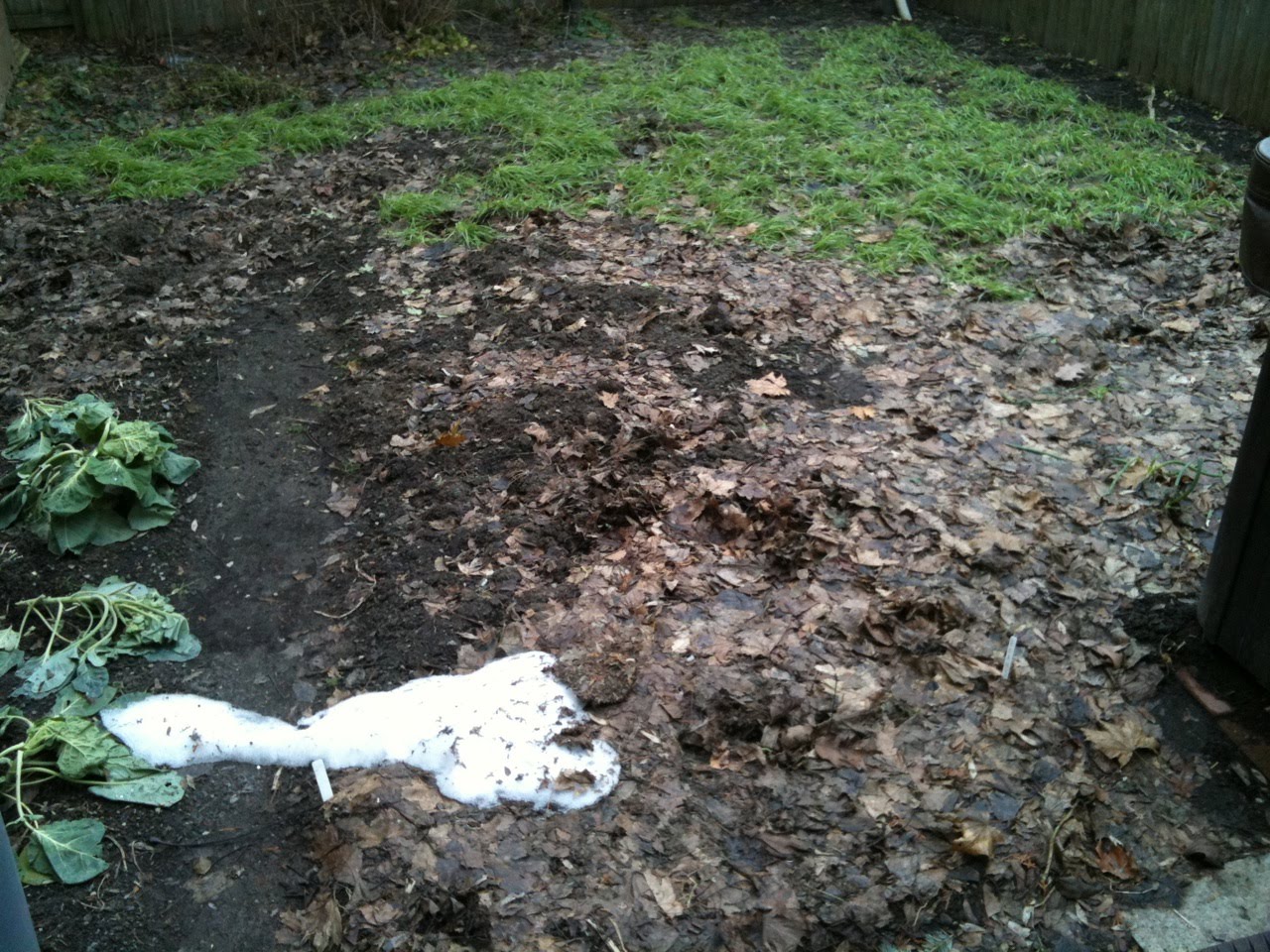
Speaking of warming temperatures, its almost time to plant the garden....well, kinda. Here is what the garden looks like 4 weeks before I am hoping to do the first plantings (the weekend of 3/13). I'm not too worried about there being snow on the ground, I'm just worried that the ground will still be frozen at this point. It wasn't last year, but I think last year was warmer than normal.

Thursday, February 3, 2011

Garden Planning

I've done a bunch of work planning for the 2011 gardening season. First thing up is the garden map. There are some big changes from last year. I'm growing less cucurbits (squashes, zuchinni and the like) since they took up so much space in the garden last year. I wish there were ultra-compact cucurbits that only produced a small amount of vegetables, but even the supposedly smaller ones like the "Spacemaster" cucumber still took up at least 16 square feet and produced more cucumbers than we could use. So this year there is a focus on a broader array of smaller plants. I'm also going to try corn in a "three sisters" arrangement. That is basically corn with pole beans climbing up the corn stalks and cucurbits growing along the ground between the corn and beans.

I've also made a spreadsheet for tentative planting dates. Its clearly aggressive in terms of early plantings, but last year I could have planted things earlier than I did. I'm going to try to plant some very hardy stuff in mid-march right before I go away for vacation. If it doesn't survive, no big deal, I'll just replant it in early april. Remember also that the garden sits in a pretty mild micro-climate, so the growing season is longer here than it would be at a regular farm.

Lastly, the seeds have been purchased! It was about $40 worth of seeds, but the purchase of a heating mat for helping seed starts plus taxes and shipping brought the total up to almost $90.

Sunday, January 2, 2011

Random Update

A couple quick updates from the homestead. First, I siphoned the wine off the sediment. The wine has been fermenting in the glass bottle at the bottom of the picture below. I siphoned it into the plastic container, cleaned out the glass container, and put it back into the glass container. I'll let it settle again and in a month or so I'll siphon it off any further sediment. I checked the specific gravity of the wine and it has fermented to moderately dry. It should be about 11.5% alcohol. I also took a sip of it, but I wasn't too impressed. It tasted somewhat too fruity, and it also has some chemically type flavors. Hopefully it will improve as it ages.

We had a recent heat wave that melted the accumulated snow in the garden. You can see the Brussel's Sprouts in the lower left corner. It looks like a couple of the plants are still somewhat alive, but I'm not sure what kind of shape they'll be in come spring.
My parents also got us a grow light setup that I expect will be a big help when it comes time to start vegetables indoors in the spring. Speaking of which.....I've started planning the 2011 garden layout, but I'm not at the point of buying any seeds yet. The biggest difference is that I likely won't be doing Zucchini or Spaghetting Squash nest year. They just took up way too much space in the garden last year. They produced well, but what do we need 35lbs of Spaghetti Squash for? Just too much production and too much space taken up by single plants. Not having those should allow for a more reasonable amount of several different types of veggies.

Saturday, December 4, 2010

Last Harvest of 2010

I decided it was finally time to pick what remained in the garden. I don't know why this picture turned out so dark, but there are brussels sprouts plants on the left (with no sprouts), arugula covered in snow in the middle left, a broccoli plant middle right, and some green onions on the far right. I left the Brussels sprouts and a few of the onions in the ground just to see what happens over the winter, and I picked the rest.
I got 1/4lb of Arugula, 1/4lb of green onions, and a small head of broccoli. Not a huge harvest, but pretty good for December!


Sunday, November 14, 2010

A Few Random Things

The homestead finally got its first killing frost on November 6th. It killed the begonias in the topsy-turvy and the "wild" tomatoes in the front yard. Those tomatoes were leftover seedlings that I didn't have room for in the garden so I planted them in an empty area of a raised bed in the front yard. The area was pretty heavily shaded, but they grew surprisingly well. I had wondered in a post this spring or summer what would happen to tomato vines that weren't supported. One website said that it would become an impeneterable tangle of disease-wracked vegetation. I decided to let these tomatoes do what they wanted and see what happened. While it was an impressive tangle of vegetation, it was very much not disease-wracked. In fact, there was no sign of the blight that affected all the tomato plants in the garden and in the topsy-turvy. On the other hand, the plants produced exactly zero tomatoes (though they did flower a bit). I don't know if that was because they were the runts of the litter that didn't get planted in the garden, the lack of sun, or if it was the lack of support and vertical growth. I do think the plants spent more of their energy on growing vines rather than growing tomatoes.

The frost did not seem to affect the other plants still growing in the garden. There is still lettuce, pak choi, arugula, green onions, broccoli, and brussels sprouts growing. When I say growing, I mean that only in the loosest sense of the word. I noticed the growth of the plants slowing down quite a bit around the beginning of October. It appears that they haven't grown at all since about mid-October, even the usually very fast growing greens. I suspect there is some minimum amount of light/energy the plants use for just basic life processes and they need more than that to grow. Its good to know for next year that nothing is really going to grow after early October. At least the plants stay alive and tasty out in the garden rather than rotting in the fridge.

The garlic that I planted has actually sprouted up above the surface. I'm a bit worried about the garlic getting damaged by the winter cold if it starts growing, but the internet says its OK if it sprouts a bit. I'm tempted to leave some of the green onions and see if they survive the winter.

On a different subject, the wine is making good progress. The fermentation has slowed dramatically. While fermentation was going strong, the wine got progressively cloudier as the yeast grew. After fermentation slowed down, the cloudiness slowly settled out. I decided to add a little bit of yeast nutrient and stir up the sediment to see if I could wake up any yeast that were just sleeping instead of dead. After a day or so it started to settle again. It looks like it will take a week or two to fully settle. After it does settle, I'll rack it off the sediment. Here is what it looked like a couple days after I stirred it.


Sunday, October 31, 2010

The 2010 Harvest

With the forecast nightly lows starting to dip below 32 degrees, I figured it was time to harvest what I could from the garden. I picked the last of the peppers and tomatoes (green). I also harvested a couple heads of broccoli. The only things I have left in the garden are the brussels sprouts (likely not going to produce anything this year, but I figured I'd leave them in just in case), one broccoli plant that is growing a head, a couple pak choi and lettuce plants, and a bunch of green onions. I then hacked up the plants that are done for the year and was going to put them in my compost pile, but I realized that the compost barrel was getting too full to really be able to mix up. The stuff in the barrel was mostly composted, so I dumped it out in a pile of leaves that I had put in the garden after I raked the front yard last weekend. The newly chopped up plants went into the barrel. So I now have a compost pile to go along with the compost barrel. You can see part of the leaf pile behind the hot tub on the right side of the picture below. You can also see the oats coming up in the areas of the garden that I planted them.In the spring I'll spread the contents of the compost pile and the compost barrel over the garden and mix it in with the dirt as a fertilizer. Between the stuff I emptied out of the barrel, the leaves, and the new stuff in the barrel, there is probably about 65-75lbs of fertilizer for next year, plus any additional stuff that we add over the winter. That seems like a lot for such a small garden, but considering the amount of vegetables that we harvested this year, that is probably necessary. How much did we harvest, you ask? Well, here is a link to the harvest summary spreadsheet. 143 lbs seems like a pretty good harvest from an area that is probably only about around 250 square feet of usable area. The prices in the spreadsheet come from Wegmans' website. I used prices for organic produce when I could find it (everything from the garden is effectively organic), and when I couldn't find it, I multiplied the price of non-organic produce by 150%. Between the CSA that we joined and the garden, Jaime and I were not really able to keep up with the amount of produce that we had. We've made the decision that next year we won't do the CSA. Instead, we will rely on the garden for most of our produce and supplement it with stuff from our neighborhood farmer's market.